where i'll be
where to find me over the next few months. if any of it lines up with where you are, come say hi :)
- 9 September 2026: Ashoka University (interviewing professors for the podcast)
- 14 September 2026: Decoded × HERizon Special Event with Cary S. Krosinsky (Yale, Brown, NYU) (a student session on sustainable finance and climate action)
- 23 September 2026: Shadow the Scientists, UCSC Lecture (Exploring the Deep-Sea Habitats of the Hawaiian Archipelago with the E/V Nautilus)
- 26 September 2026: Lodha Genius Roundtable Discussion Session (as should all LGP alums!)
- 3–5 October 2026: Hack Nation Global AI Hackathon (i also have an organiser's referral code for people i think are amazing, so message me if you want it)
- 5–15 October 2026: Andaman & Nicobar Islands (travelling)
- 30 October–1 November 2026: ConfAI 2026, Plaksha University (invited to the AI conference in line with my work on AI Policy!)
- 12 November 2026: Y Combinator Startup School Taipei
- 18 November 2026: NYAS 208th Annual Meeting (as a Member and Fellow)
research
I am currently working on a study that tests whether fear of missing out (FOMO) and conscientiousness interact to predict financial misinformation sharing. It extends Professor Kakkar’s framework on political ideology, conscientiousness, and fake news sharing into a financial context, with FOMO taking the place of ideology. checkout more details here, and the GitHub here.
Oct 13th Update: I have closed the data collection and survey part after receiving 311 eligible responses, and am now running the main analysis.
building
back to running the Edunomix India Chapter day to day, the 501(c)(3) chapter i founded to teach economics to students who need it. i'd stepped back for a while under other commitments (don't worry guys i aced my board exams), and it is good to be in it properly again.
Oct 1st Update: we have officially closed the entries for the Edunomix India Essay Competition, receiving hundreds of entries from all across India (over 24 states!), and are now in the process of reviewing it. The results will be announced by 1st November.
right now, that mostly means reviewing entries for the second edition of our nationwide essay competition. the submission deadline has now passed, and I’m mostly spending my time reading and evaluating essays from students in Classes 6 to 12, as well as first-year university and gap-year students, responding to five prompts on questions that matter for India, along with our other judges from our wonderful panel. the top entries will go on to join the Edunomix India research team, and I am really excited to soon announce the winners :)
we have also partnered again with Learn and Teach UA for this season's Ukraine Speaks English seminars, free financial education for students across Ukraine whose schooling has been disrupted.
writing
most of my writing now goes into the financial misinformation study above, which is a different craft from an essay. for my shorter pieces, checkout the writing page!
recording
Oct 14th Update: WE JUST GOT A NOBEL LAUREATE TO AGREE TO AN INTERVIEW. We'll officially be interviewing Peter Hegemann, 2026 Nobel Prize in Physiology or Medicine, next week!
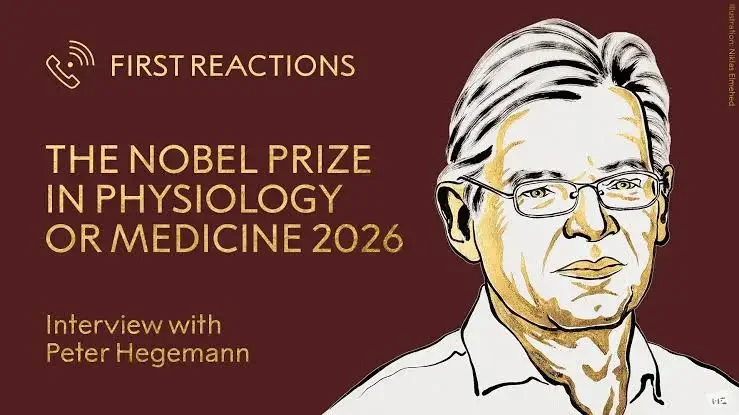
Peter Hegemann, 2026 Nobel laureate in Physiology or Medicine. Illustration: Niklas Elmehed, Nobel Prize Outreach.
upcoming episodes for the Decoded Podcast:
- Peter Hegemann, 2026 Nobel Prize in Physiology or Medicine, Professor @ Humboldt University of Berlin (Date: Next Week)
- Ram Sewak Sharma, CEO @ National Health Authority and the Innovator @ Aadhar Card (Date: Not Confirmed)
- Ashok Kantha, Former Ambassador of India to the People’s Republic of China (Date: 10th November)
- Eduard Talamàs, Professor @ IESE Business School and PhD @ Harvard University (Date: 25th November)
- Sundar Sarukkai, World Famous Philosopher (Date: Not Confirmed)
- Dr Mahendra Kumar Singh, Professor Ph.D., Assistant Professor @ DDU Gorakhpur University (Date: 9th October)
- Dr. Ajay Shah, Professor @ National Law School of India University, PhD @ USC, BTech @ IIT Bombay
we have also been building our team, and are actively hiring newsletter associates, so if you would like to join, email Anya (our Head of the Newsletter department) at anya@thedecodedpodcast.com!
side projects
i've also been exploring a lot of different projects and skillsets over the last few months, so as to utilize my gap year to the fullest, while also gaining experience in technical skills to be able to conduct more efficient econ research in uni. checkout a few below:
- built Forge, a computational research lab where specialist agents turn one question into cited evidence, a falsifiable hypothesis, a preregistered experiment, and a changed next decision (GitHub) (October 2026)
- built Scout, an autonomous voice agent that calls local service providers, compares quotes, and negotiates using only verified competitive leverage (GitHub) (August 2026)
- building Project Fermat, a small volunteer initiative helping middle school students in underserved schools across Delhi NCR build a foundation in olympiad mathematics. for more details, and to volunteer, email us at theprojectfermat@gmail.com (September 2026)
- working on Sensitivity Model for Multi-Credit Calibration, a project that extends Baker & Capponi, Multi-Credit Calibration via Elastically Stopped Lévy Processes (2026), with two friends of mine (GitHub) (October 2026)
learning
code mixing, how to be technical, and even more number theory.
in October, i also started learning linear algebra and advanced python. the linear algebra is mostly self-taught, through YouTube and MIT OpenCourseWare.
reading
The Penguin History of the World, by J. M. Roberts & Odd Arne Westad (Sixth Edition)
off the desk
i ran my first half marathon this year!
reaching out
deliberately talking to more people, researchers, writers, anyone building something they care about. the most useful hour in my week is usually a conversation I did not strictly have to have. researching something? talk to me!
saying no to
most things. it took me a while to learn that a calendar with no gaps in it is not a sign of ambition, it is a sign of poor editing.
this is a now page, an idea I stole from Derek Sivers. the premise is that an About page tells you who someone has been, and a Now page tells you who they are this month. if we have spoken before and this is out of date, that is on me. nudge me.